


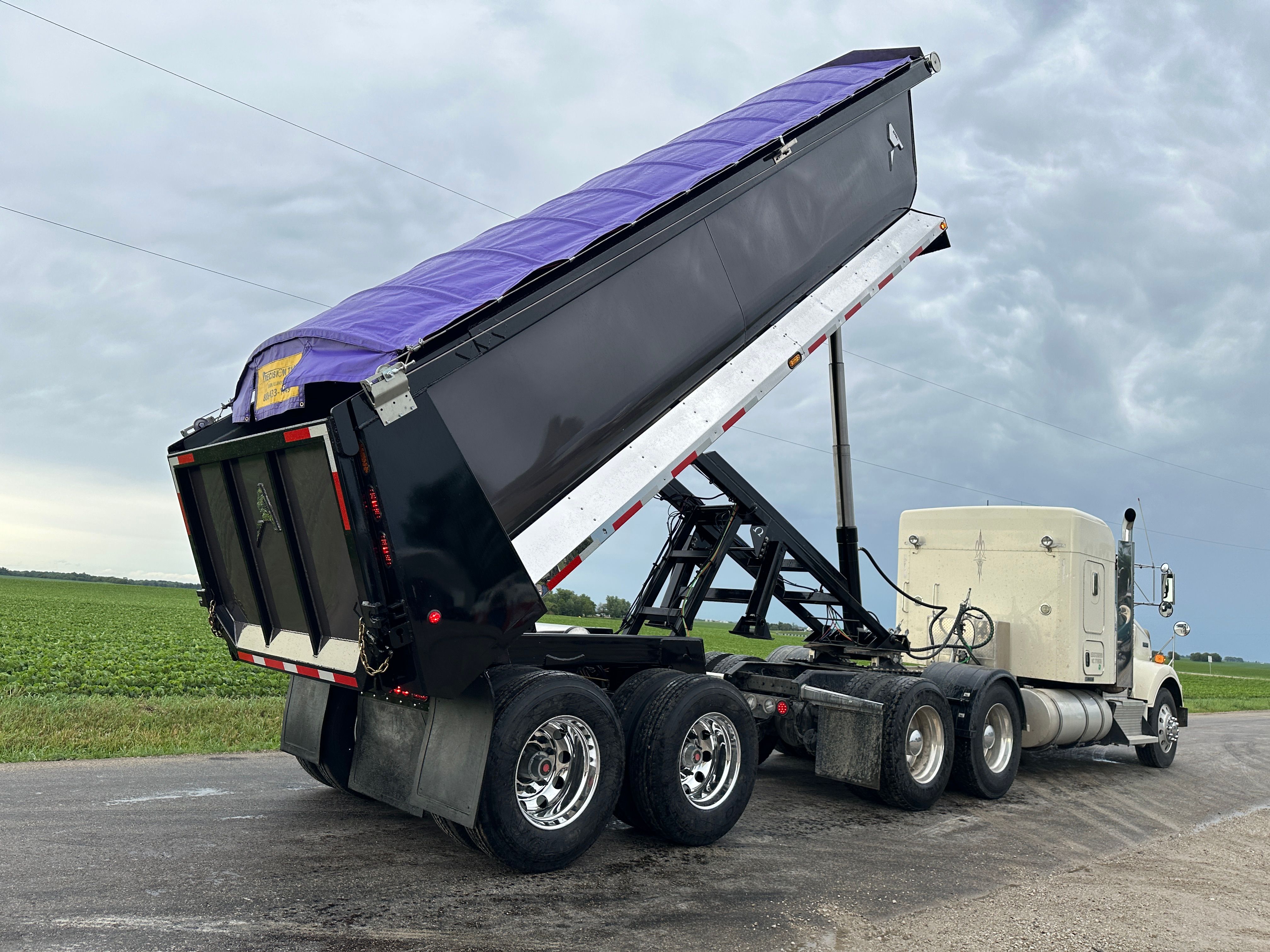
Can Your Truck Actually Tow That Dump Trailer A Guide to Weight Ratings, Tongue Weight, and Safe Matching
t
tj@civsav.com
© 2026 Civilized Savage
Based in USA
tj@civsav.com
Here's a scenario that plays out at trailer dealerships every week. A buyer picks out a beautiful 14,000-pound GVWR dump trailer, hooks it to his half-ton pickup, and pulls away perfectly happy because empty, the combination feels fine. The problem doesn't show up until the first real load of gravel, when the truck squats, the steering goes light, the brakes fade on the first long downhill, and the driver discovers that "my truck can pull it" and "my truck can tow it safely and legally" are two very different statements.
The dump trailer itself is only half of the equipment decision. The other half the one far more often gotten wrong is the tow vehicle. Overloading a truck-and-trailer combination isn't just hard on equipment; it's a genuine safety hazard, a legal liability in any accident, and in commercial applications, a DOT violation waiting at the next scale. This guide walks through the weight ratings that actually govern what you can tow, the math for matching a truck to a loaded dump trailer, and the equipment details hitches, brakes, tongue weight that make the combination work in the real world.
Trailer towing is governed by a handful of ratings, and every one of them is a hard limit set by the manufacturer, not a suggestion.
GVWR (Gross Vehicle Weight Rating) is the maximum a single vehicle can weigh fully loaded. Your truck has one; your trailer has one. A trailer with a 14,000 lb GVWR may legally weigh 14,000 pounds total trailer plus cargo and not a pound more. We touched on how trailer GVWR relates to what you can actually carry in our breakdown of dump trailer payload capacity, productivity, and hauling costs; the short version is that payload equals GVWR minus the trailer's empty weight.
GCWR (Gross Combined Weight Rating) is the number most buyers have never checked the maximum allowable weight of truck, trailer, cargo, passengers, fuel, and gear all together. This is the rating that ultimately decides whether a combination is legal.
Towing capacity is the marketing number on the window sticker, and it comes with an asterisk the brochure doesn't emphasize: it's calculated with a nearly empty truck. Every pound of tools, fuel, passengers, and equipment in your truck subtracts directly from what you can tow.
Truck payload matters more than most people realize, because of tongue weight — which we'll get to shortly. A heavy trailer's tongue can consume a huge share of a truck's payload rating before you've loaded a single toolbox.
Let's run real numbers. Say you're eyeing a tandem-axle 14,000 lb GVWR dump trailer, a workhorse size for contractors, and squarely in the territory we covered in what size dump trailer do you need. The trailer weighs roughly 4,500 lbs empty, giving you about 9,500 lbs of payload. Call it a legitimate load of gravel or demolition debris.
Now the truck. A typical well-equipped half-ton might advertise 11,000+ lbs of towing capacity, which sounds comfortably adequate. But check the rest of the sheet: its GCWR might be around 17,000 lbs and its payload around 1,700 lbs. Load the truck with a driver, a passenger, fuel, and 400 lbs of tools, and here's what happens. The loaded trailer weighs 14,000 lbs. Proper tongue weight at 12% is 1,680 lbs which alone essentially consumes the truck's entire payload rating before anyone sits in the seat. And truck (say 7,500 lbs loaded) plus trailer (14,000 lbs) totals 21,500 lbs against a 17,000 lb GCWR. The combination is thousands of pounds illegal, with the tow vehicle's rear axle, brakes, and frame all operating past their engineering limits.
The same trailer behind a properly spec'd three-quarter or one-ton diesel with a GCWR in the mid-20,000s and 3,000–4,000 lbs of payload is a safe, legal, everyday combination. Same trailer, completely different outcome. This is why matching the tow vehicle belongs on any list of purchase considerations, right alongside the errors we cataloged in the top 5 mistakes to avoid when buying a dump trailer buying more trailer than your truck can handle is arguably mistake number six.
One more wrinkle worth knowing: material choice shifts this math meaningfully. Because aluminum trailers weigh less empty, more of the GVWR becomes usable payload or, viewed the other way, you can haul the same load with a lighter combination that's easier on your truck's ratings. It's one more dimension of the tradeoff we explored in steel vs. aluminum dump trailers.
Tongue weight the downward force the trailer coupler puts on the hitch should run roughly 10–15% of the loaded trailer's total weight. Get it wrong in either direction and the combination becomes dangerous in different ways.
Too little tongue weight (load shifted rearward) is the classic cause of trailer sway the terrifying fishtail that amplifies with speed and has put countless rigs in the median. Too much tongue weight overloads the truck's rear axle, lifts weight off the steering axle, and produces that light, wandering front end that makes an overloaded truck feel so unnerving.
For dump trailer owners, tongue weight is a loading discipline as much as a buying one, because unlike an enclosed trailer with fixed cargo, your load placement changes with every bucket. The rule: center the load slightly forward of the axles, keep it low, and load evenly side to side. A skid steer operator dumping every bucket at the tailgate end is manufacturing a sway event. These habits belong in the same operational playbook as the loading and cycle practices from our post on dump trailers and jobsite efficiency in material handling.
Trailer brakes are not optional at these weights. Virtually every state requires brakes on trailers above a modest threshold, and any dump trailer worth owning has electric brakes on its axles. Those brakes are only as good as the brake controller in the tow vehicle and a controller that's poorly adjusted is nearly as bad as no brakes at all. A proportional controller, properly gained for the load you're carrying that day (a loaded dump trailer needs a very different setting than an empty one), is the difference between the trailer helping you stop and the trailer pushing you through an intersection.
The hitch system has its own ratings. Receiver hitch class, ball mount, and ball must each be rated for your loaded trailer weight; a 10,000 lb rated ball under a 14,000 lb trailer is a failure point, full stop. Heavier dump trailers frequently move to gooseneck configurations precisely because they place tongue weight over the truck's rear axle, dramatically improving stability and payload utilization on properly equipped trucks.
Safety chains, breakaway systems, and wiring round out the connection. The breakaway battery — the small unit that applies trailer brakes if the coupler ever separates should be tested regularly, a two-minute check that belongs in the same routine as everything in our trailer maintenance guide.
The takeaway for buyers is a shift in mindset: you're not purchasing a trailer, you're building a combination, and the combination is only as capable as its weakest rating. Before signing for any trailer, pull your truck's door-jamb sticker and owner's manual, find the GCWR and payload numbers (not the brochure towing number), and run the math with realistic loads and realistic tongue weight. If the numbers don't work, the answer is either a lighter trailer, a lighter material, or a heavier truck, never wishful thinking.
For businesses, this matching exercise scales up: a fleet where every truck can handle every trailer is dramatically more flexible than one full of one-off pairings, a principle that runs through our guide to dump trailer fleet strategy, profitability, and efficiency. And if the right combination requires equipment investment, spreading that cost is exactly what we covered in how to secure equipment financing for your small business .
A properly matched truck and dump trailer is a pleasure to work with, stable at highway speed, confident on grades, predictable in the rain, and legal at every scale. A mismatched one is a daily gamble with your equipment, your business, and everyone sharing the road.
ALKO Dump Trailers builds heavy-duty dump trailers across the size range and helps buyers get the whole combination right, from GVWR selection to hitch configuration, before the first load ever goes in the bed. Tell us what you tow with and what you haul explore our dump trailer lineup for a matching recommendation built around your truck, your loads, and your routes.